
What Is Mulhoe? The History of Korea's Chilled Raw Fish Soup
Mulhoe · Sokcho Hangari Mulhoe
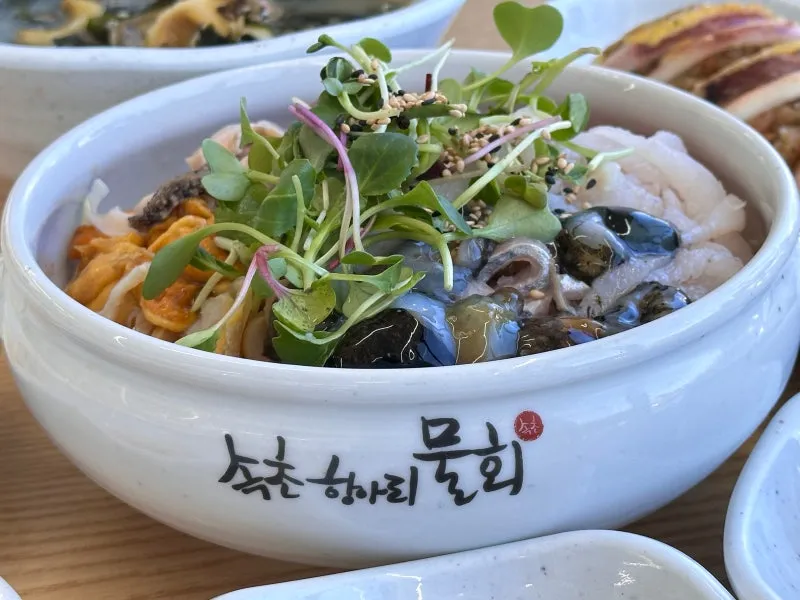
Visit Sokcho in summer and sooner or later someone will say, “Let’s go eat mulhoe.”
Yet surprisingly few people know where this icy bowl came from. We explain it to guests fairly often, and they tell us it tastes different once they know the story.
So here it is.
A dish born on fishing boats
Mulhoe traces back to the working life of fishermen on Korea’s east coast.
For crews heading out before dawn, the hard problem was eating. You cannot easily use fire on a boat — especially the wooden boats of earlier generations — and cooking rice in a cramped space with waves rolling under you is no small task.
So they improvised. Slice part of the fresh catch straight into a bowl, stir in gochujang or doenjang, pour in cold water, and drink it down.
No fire, few dishes, and above all fast. You could tip the bowl back with one hand and keep working with the other.
The name says it plainly: mul (water) + hoe (raw fish) — raw fish taken with water.
A rough working meal is now the east coast’s signature dish, with queues out the door in summer. Foods survive for a reason, and in mulhoe’s case the reason was simply that it tasted good.
With ingredients that fresh, of course it did
Think about it. A fisherman eating fish he caught minutes earlier. No restaurant on earth can beat that for freshness.
That is also why we still get our seafood straight from fisherman friends at dawn. With mulhoe, freshness is the flavour.
What makes Sokcho-style different
Mulhoe is eaten all along the east coast, but styles vary a lot by region. Same name, yet you may wonder whether it is even the same dish.
Sokcho and the Gangwon coast
Squid and raw fish with a sweet-tangy gochujang broth poured over.
The defining feature is flaked ice. The broth is made ahead, chilled hard, and served with ice so the temperature holds to the last mouthful.
There is also a strong culture of adding thin noodles and then rice. You don’t just eat the fish — noodles first, rice second. One bowl, three different experiences.
Pohang (North Gyeongsang)
Here the older method survives: mix rice in with the fish, then pour water over it. Thick gochujang seasoning dominates, with the sauce leading rather than the broth. Denser and heavier than the Sokcho version.
Jeju
Completely different. The broth is doenjang-based, with damselfish or baby squid — the famous jari-mulhoe and hanchi-mulhoe.
Using soybean paste rather than chilli paste changes both colour and flavour entirely: nutty and mild. Adding sancho (Korean pepper) leaves for aroma is a Jeju signature.
For Sokcho, it comes down to the broth
The heart of Sokcho-style mulhoe is the broth. Made in advance, chilled, and poured with flaked ice.
That is why people finish every drop, and why the last spoonful of rice tastes so good.
It is also why we insist on earthenware pots — thick ceramic grips the cold so that chill survives to the end.
Why summer?
Cold broth pulls down the heat of a tired body, and the sour edge revives a flagging appetite.
That is why a bowl of mulhoe tastes so extraordinary on a drowsy afternoon after swimming, or after sweating your way down a mountain. It is precisely what your body wants when it wants something cold.
But it’s really a year-round dish
Many people think of it as summer food. It isn’t.
Plenty of Sokcho locals eat mulhoe for breakfast as a hangover cure. Cold broth settles the stomach, and it is especially good the morning after drinking. That’s part of why we open at 9 a.m.
And a good number of our regulars insist winter mulhoe is the best version. Eating something ice-cold in a warm room is a pleasure only locals seem to know about. Fish also carries more fat in winter, which can make it taste even better.
What survives
Today’s mulhoe is far from the version eaten on boats. The broth is refined, the ingredients are varied, the vessels are beautiful.
The essence is unchanged though: the freshest possible ingredients, as cold as possible, as refreshing as possible.
That is all we really do here. Take the best of what our fisherman friends bring in that morning, pour over a broth we have spent years refining, and serve it in an earthenware pot.
Trying mulhoe in Sokcho
Sokcho Hangari Mulhoe makes Sokcho-style mulhoe right in front of Sokcho Beach.
Serving it in custom earthenware is our own approach — the thick pot holds cold far longer than a standard bowl.
We are a 3-minute walk from Sokcho Express Bus Terminal, with a very large car park. And because the beach sits directly behind us, you can walk out for a stroll or a swim right after eating.
See the menu and prices · Directions
Trying it for the first time? Read our beginner’s guide to eating mulhoe — just knowing the order makes it noticeably better.
You may also like