
Why We Serve Mulhoe in an Earthenware Pot
Mulhoe · Sokcho Hangari Mulhoe
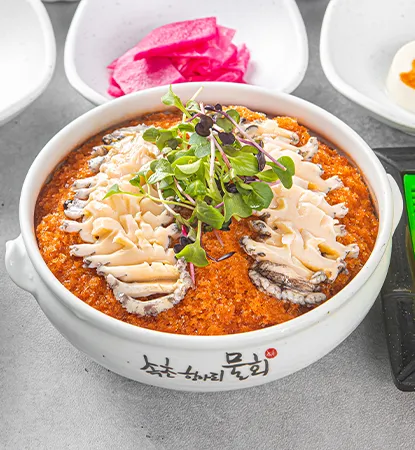
Our name contains the word “hangari” — the Korean earthenware pot. It isn’t decoration. Your mulhoe genuinely arrives in one.
First-time guests almost always react the same way when it lands on the table. “Wait, what is this?” Then out come the phones. But we don’t use these pots because they photograph well. There’s a real reason.
Temperature is everything
Mulhoe is at its best when it is cold. Anyone who has eaten it knows this. That first shockingly cool spoonful is half of what the dish is.
The problem is that an ordinary bowl cannot hold that cold.
Serve mulhoe in a thin bowl indoors in midsummer and it starts going lukewarm within ten minutes. The flaked ice is long gone and the crispness with it. By the time you add the noodles you are eating a different dish.
That is why we use earthenware.
Thick ceramic walls hold cold the way a thermos does. We chill the pots in advance, pour in ice-flaked broth, and the pot keeps gripping that cold.
So through the raw fish, through the noodles, and right down to the rice you stir in at the end, it stays as cold as the first bite. Korean TV crews who film here always end up mentioning the pot.
Heavy, but we won’t give them up
Honestly, these pots are a nuisance. They are much heavier than normal bowls, harder to wash, and they break when dropped. They are hard on our staff’s wrists.
We keep them anyway. Without them it isn’t our mulhoe. The inconvenience buys that moment when a guest says, “It’s still cold.”
A broth perfected over years
Half of mulhoe is the broth. The other half is the seafood. No matter how good your fish is, the wrong broth and you don’t have mulhoe.
We hold to three principles.
One: never mask the ingredients. Overpowering seasoning erases the taste of the fish — which would make expensive wild-caught seafood pointless. Sweet-tangy notes lead, then step back so the natural sweetness and texture come forward.
Two: finish clean. It cannot leave your mouth heavy or make you thirsty. Only a clean finish gets people to say, “I drank the whole thing.”
Three: spicy, but not punishing. Our mulhoe is on the spicy side. It is not a mild dish. It won’t hurt your tongue though, and unless you truly cannot handle chilli, you will be fine. Holding that line is trickier than it sounds.
Balancing all three took years. We still adjust with the season and the state of the catch.
Why we insist on wild-caught
Our sea cucumber and abalone are wild-caught.
The cost difference is significant. Farmed would be easier and more profitable. We use wild because you can taste it.
Wild sea cucumber has a distinctly firmer, crunchier bite. It keeps its spring, so it holds its own inside the bowl.
Wild abalone gets sweeter the longer you chew. Never tough — chewy in a good way, with a faint sea aroma inside.
Our signature sea cucumber and abalone mulhoe was featured on KBS 2TV’s evening food programme. It is the dish we recommend with the most confidence.
When it isn’t good, we say so
We don’t force ingredients like squid, whose catch swings wildly. When prices spike we price honestly at market rate, and on days when the quality isn’t there we simply don’t sell it.
Guests sometimes ask why. We hear it fairly often. We still think it beats serving something mediocre. And we would rather not embarrass the fisherman friends who bring it in.
The mix changes with the season
One thing worth knowing in advance. The fish and shellfish in our mulhoe change through the year.
We use whatever is best right now, and during Korea’s legally mandated closed seasons certain species are simply unavailable to us.
So please treat the photos on this site and on our menu as examples. The same dish in spring and in autumn may be composed a little differently. Whenever you come, we fill it with the best of that moment. That is how we work.
Good ingredients, cleanliness, kindness
There is no grand philosophy here. Those three things are all we try to hold to.
Use good ingredients, keep the kitchen clean, treat people well. Obvious, maybe — but doing it every single day is harder than it sounds.
Come to Sokcho Beach and try real Sokcho mulhoe in an earthenware pot. Afterwards, go up to our top-floor Sky Stairs viewpoint for a photo of the sea.
See the menu · Directions and parking · FAQ
New to mulhoe? Read how to eat it properly first.
You may also like