
Sokcho Tourist & Fishery Market — the Dakgangjeong Queue, the Word 'Market Price', and How Buying Raw Fish Actually Works
Sokcho travel · Sokcho Hangari Mulhoe
Prices and hours verified as of: 2026-08-15
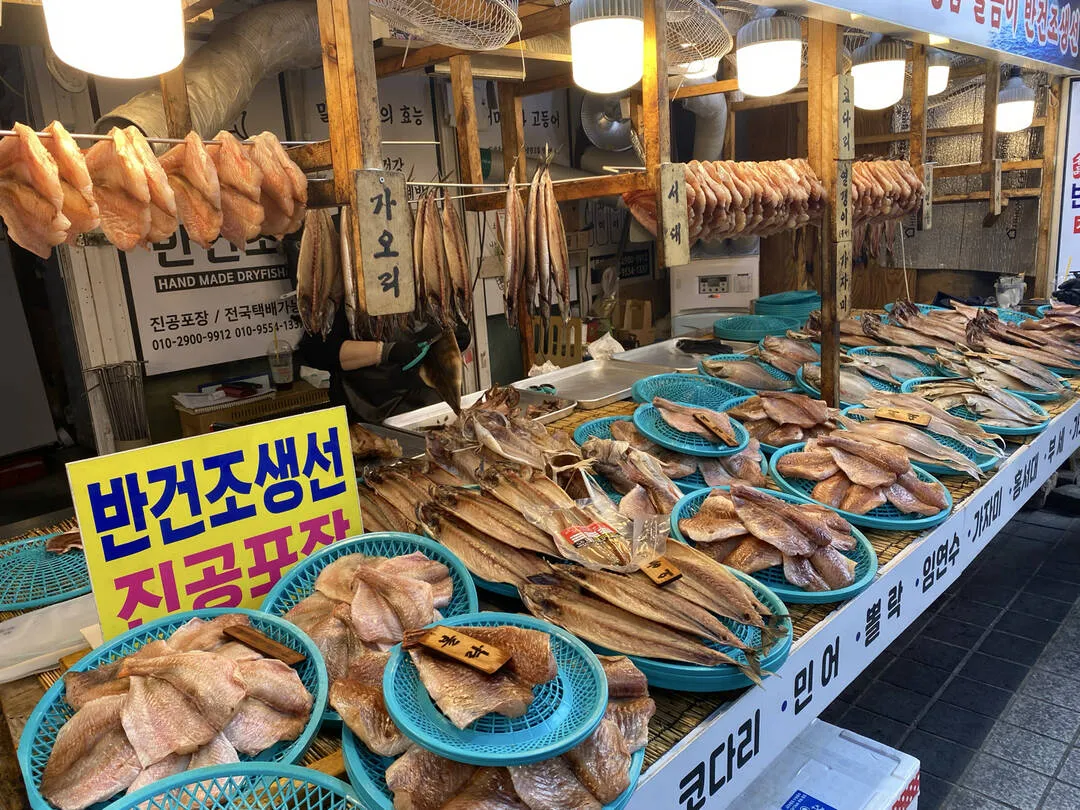
The place most visitors to Sokcho end up spending their afternoon is not Seoraksan, and it is not the beach.
It is the market.
We are ten minutes away by car, so I give directions to it several times a day. After years of that, I have noticed people get stuck at exactly the same points — so here they all are, in order.
First: it has two names
Sokcho Tourist & Fishery Market and Sokcho Central Market are the same place.
It was Central Market originally and was renamed in the 2000s. Locals still say “Central Market,” and plenty of older signs and blog posts still call it that.
Either name works with a taxi driver, and both bring it up in Naver Map. You are not looking for two different markets.
The layout — know this and you will not wander
One building, and each floor has a completely different character.
| Floor | What is there |
|---|---|
| Basement | The raw fish centre — live fish and shellfish you pick yourself |
| Ground floor | Food, vegetables, side dishes. Where visitors spend the most time |
| Second floor | Clothes, household goods, sundries. Almost no tourists go up |
Outside the building, the market continues as lanes of small shops — including the alley where the dakgangjeong places are clustered.
For a visitor, that is really it: the basement, the ground floor, and the lanes outside.
Dakgangjeong — you will end up queueing
Sokcho’s dakgangjeong — crisp fried chicken in a sweet-spicy glaze — is famous across the country now. There are several shops inside the market, and the well-known ones always have a line.
The worst times are predictable:
- Weekends, 12:00–15:00 — the peak. Budget thirty minutes or more
- Holidays and midsummer — double that
The fix is simple: go in the morning. Between 10 and 11 the same shop moves far faster. After 19:00 it usually thins out too.
One thing worth knowing: dakgangjeong is built to be eaten cold. Plenty of people prefer it after it has sat a while and the glaze has soaked in. So buying a box to eat back at your accommodation is not a compromise — it works.
“Market price” on the label is not a scam
You will see 시가 (siga), “market price”, where a number should be. No figure at all.
This is the thing foreign visitors find most unnerving, and I want to be clear: nobody is setting you up.
Squid is the usual example. Depending on the catch and the closed season, the wholesale price moves day to day — sometimes several times over. A printed price would be wrong by lunchtime. Our own menu lists squid dishes the same way, for exactly the same reason.
There is one correct response: ask before you buy. Point at it and say “얼마예요?” (eol-ma-ye-yo — “how much?”). They will tell you on the spot. And if you hear the number and walk away, nobody minds. That is what a market is.
Buying raw fish: the part that catches everyone out
If you buy sliced raw fish in the basement, you do not eat it there.
You carry it up to one of the nearby restaurants, pay a table charge, and eat it there. Lettuce, chogochujang sauce, a spicy fish stew and the side dishes come with that charge.
This is where first-timers get confused: “I already paid for the fish — why am I paying again?” But the fish and the table are, and always have been, two separate things.
- The table charge is usually per person
- Ask before you buy the fish — “where do I eat this, and how much is the table?”
- Settle the number up front and there is no unpleasant surprise later
If the whole arrangement sounds like too much trouble, going to a restaurant that simply serves you fish is perfectly reasonable. There is no right answer, only preference.
Worth carrying home
- Half-dried fish — pollock, flounder, atka mackerel. That is the photo at the top of this article. Freeze it and it keeps for a long time
- Squid sundae and abai sundae — dishes that came from Abai Village, sold here too
- Sulppang — a steamed bun leavened with makgeolli. A market speciality that surprisingly few visitors know about
- Dried seafood and salted seafood — many shops vacuum-pack, which makes them easy gifts
Parking — the real problem
Honestly: in high season, parking here is miserable.
The market lot holds around 350 cars, which is not small, and on a weekend afternoon the queue to get in still backs up onto the road. Circling for thirty minutes is a real outcome.
- Rates — paid 08:00–21:00. Spend 10,000 won or more in the market and you get a 30-minute free voucher
- Outside those hours it is free
Realistic alternatives:
- Come in the morning. Before 11:00 there is usually space
- Leave the car. The market is in the middle of town — buses and taxis are easy
- Chain it on foot — Abai Village and the gaetbae are a ten-minute walk from here. Ride the ferry, loop the village, come back, and one parking spot covers two sights
What time to go
Shops vary, but most open around 08:00. Some close early in the evening, so arriving late can mean missing what you came for.
The best window is 10:00–11:00:
- almost everything is open
- the dakgangjeong queue is short
- there is parking
- the stalls are at their fullest
One last thing
A market is somewhere to buy things, but it is also the fastest way to understand what kind of town Sokcho is.
What is spread across those stalls came out of the East Sea that morning. When the season turns, the stalls turn over completely: the space where squid was piled in summer holds sandfish and sand lance by winter.
Walk one loop and note what is in season, and you will also know what is in the bowl of mulhoe you eat that evening.
When the market has made you hungry, come down to the sea. Ten minutes by car.
See the menu · Find us · +82-33-635-4488
You may also like