
Ulsanbawi Hike — 808 Steel Steps, Four Hours Round Trip, and Honestly How Hard It Is
Sokcho travel · Sokcho Hangari Mulhoe
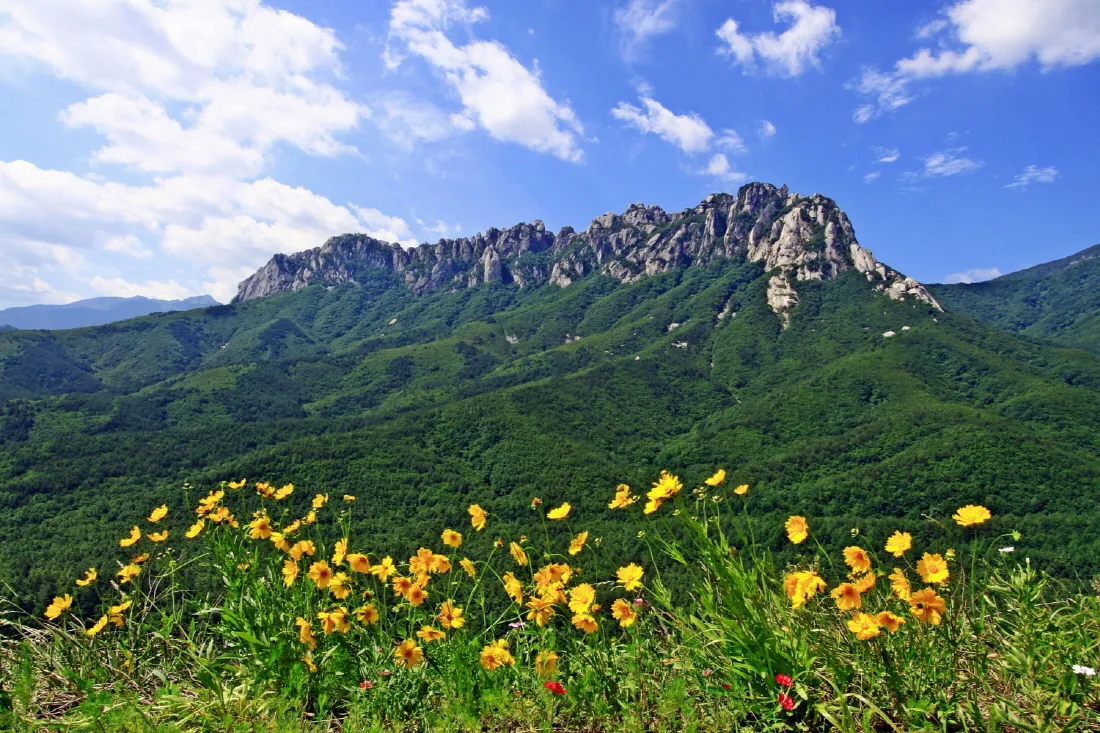
From the third-floor window of our restaurant we look at Seoraksan every day.
The one that stands out is Ulsanbawi — six granite peaks lined up like a folding screen. See it once and you do not forget it.
I usually point guests towards the cable car. But every so often someone says:
“Actually, I’d like to properly walk.”
This is for them.
First, honestly: how hard is it?
“How hard is it?” is the question I get most from foreign visitors, so let me answer it before anything else.
| Distance | About 7.6 km round trip from Sogongwon (3.8 km each way) |
| Time | Around 4 hours return; 5 if you take it easy |
| Summit | About 873 m above sea level |
| Difficulty | The first two thirds are mild — the last kilometre is all stairs |
Here is the shape of it.
The first two kilometres are a gentle forest path, and you will think this is easier than I expected. Then you pass Heundeulbawi, the steel staircases begin, and they do not stop until the top.
808 steps. Somebody counted.
Nothing is technical. No scrambling, no exposure, nothing dangerous. It is climbing stairs, continuously. That is all it is, and that is exactly why it is hard.
So — can I do it?
An honest set of yardsticks:
- You are fine with walking and can climb ten flights without stopping → yes, you can do this
- Bad knees → the descent is the problem, not the climb. Bring poles
- With children → upper primary age and above generally manage it. Younger than that, going only as far as Heundeulbawi is a good day out in itself
- Complete beginner → possible. Just give yourself more time — plan 5 to 6 hours rather than 4
Turning back is not failure. Heundeulbawi and back is a two-hour walk that is worth doing on its own.
The route — where it changes character
Sogongwon → Sinheungsa (about 20 min, flat)
You start at Sogongwon in Seorakdong, where the huge bronze Buddha stands. Wide, level path — this is your warm-up.
Use the toilets here. Facilities thin out sharply above this point.
Sinheungsa → Heundeulbawi (about 1 hour, steady climb)
Forest trail following the valley. There is a gradient, but nothing that leaves you gasping.
Heundeulbawi — “rocking rock” — is a boulder that shifts slightly when you push it. The story everyone tells is that it moves exactly the same amount whether one person pushes or ten. Everyone has a go, everyone takes the photo.
That is roughly two hours return. Plenty of people turn around here, and it is a perfectly good decision.
Heundeulbawi → summit (about 1 hour, the stairs)
This is the real part.
Steel staircases bolted to the rock face, one after another. There is almost no flat ground to break the rhythm — which is precisely what makes it tiring.
But turn around and you are paid back. The higher you go, the wider Sokcho and the East Sea open up behind you. When it gets hard, turn around often: it is a legitimate excuse to rest, and that is when the photographs are best anyway.
The summit
There is a viewing deck on top of one of the six peaks. It is open on every side — the Seoraksan ridgeline, the town of Sokcho and the East Sea all at once. On a clear day you can see to the far edge of the water.
It is windy. Even in summer the summit is cool.
Fees and what to bring
| National park entry | Free |
| Sinheungsa temple fee | Free — abolished in May 2023 |
| Parking | About 6,000 won |
Plenty of older blog posts still say you have to pay a temple admission fee. You do not. That information is out of date.
Bring:
- Water — at least a litre. Assume there is nowhere to buy any on the way
- Hiking shoes, or trainers with real grip — it is all stairs, and smooth soles are a bad idea
- Poles — essential if your knees are at all doubtful. The descent feels completely different with them
- A windproof layer — the summit is noticeably colder than the bottom
- Something to eat — gimbap tastes strangely excellent up there
What time to set out
Start early — ideally between 8 and 9 in the morning.
Three reasons:
- It is cooler. Doing the stair section in the middle of a summer afternoon is genuinely miserable
- It is quieter. The staircases are narrow, and crowds create queues on them
- You see more. Haze and cloud tend to build through the afternoon
Autumn foliage season (mid to late October) needs an even earlier start. It is the busiest time of year on Seoraksan and the jam begins at the car park. We wrote about foliage timing separately.
Ulsanbawi or the cable car?
They leave from the same place and are completely different days.
| Ulsanbawi hike | Seoraksan cable car | |
|---|---|---|
| Time | 4 hours return | 1–2 hours return |
| Fitness | Required | Barely any |
| What you get | The view from having climbed it | The view from the car |
| Who it suits | People who want to walk | Older visitors, children, anyone short on time |
You can do both in one day. If you do, hike Ulsanbawi first and take the cable car in the afternoon. The other order does not work — your legs will not cooperate.
Afterwards
Summit and back usually puts you at the bottom around 1 or 2 in the afternoon. And extremely hungry.
Seorakdong to central Sokcho is 15–20 minutes by car. We are on Sokcho Beach, a little further on.
After four hours of stairs, cold food goes down best. A bowl of mulhoe will be the easiest thing you eat all day — the broth comes half-frozen, and you will understand at the first spoonful.
When people come in straight off the mountain, we can usually tell. There is a particular look.
See the menu · Find us · +82-33-635-4488
You may also like