
Goseong Unification Observatory — Where You Can See North Korea, and How to Get In
Sokcho travel · Sokcho Hangari Mulhoe
Prices and hours verified as of: 2026-08-07
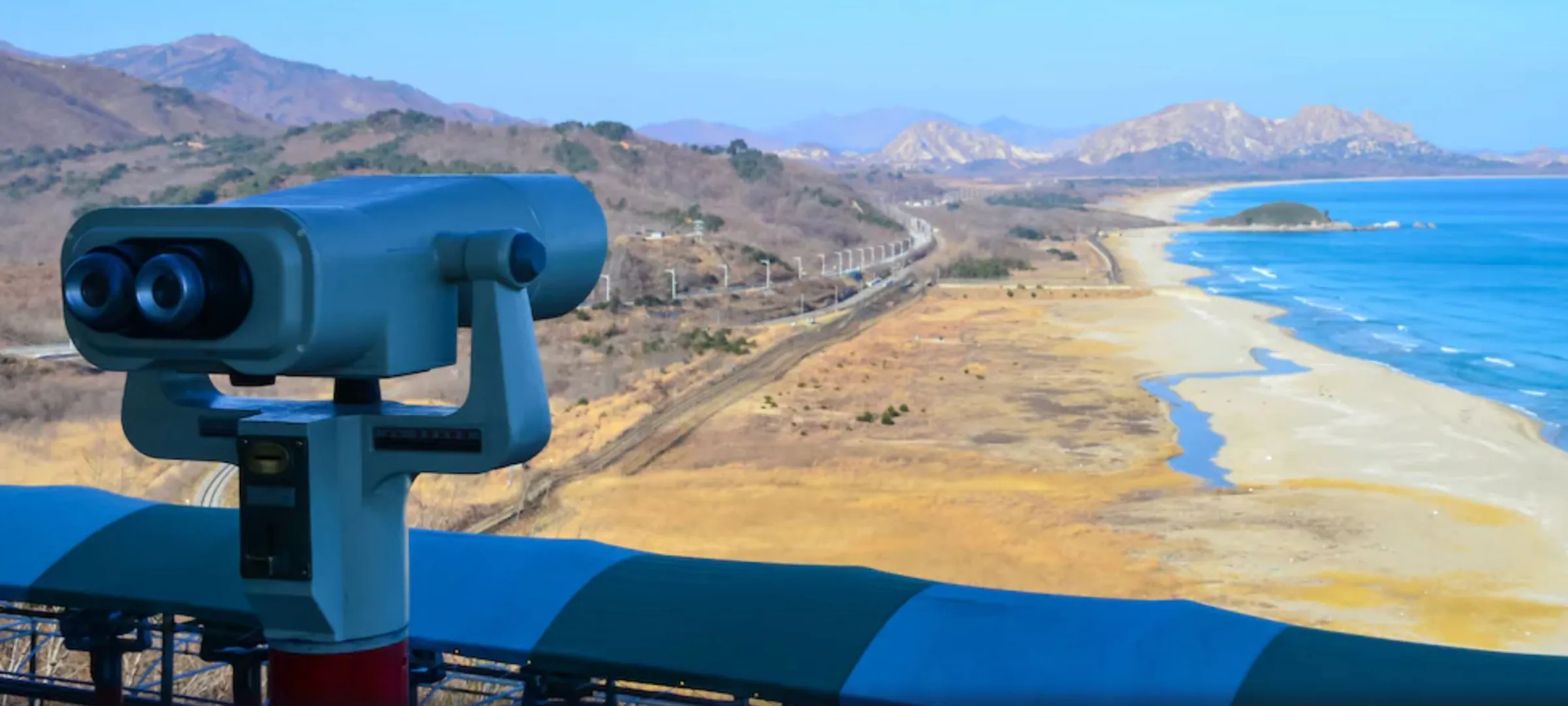
One of the questions we hear most often from visitors to Korea is this.
“Is there anywhere you can actually see North Korea?”
There is. And it isn’t the place most travellers have heard of (Panmunjom, Imjingak) — it’s a seaside observatory 50 minutes by car from Sokcho.
I was born and raised in Sokcho and I still run a mulhoe restaurant in front of Sokcho Beach. I’ve told guests about the Unification Observatory so many times that I decided to write the whole thing down properly. I mentioned it briefly in two hours from Seoul, the Korea most visitors never see — this time, in full.
The basics at a glance
| Item | Detail |
|---|---|
| Location | Hyeonnae-myeon, Goseong County, Gangwon State (the northernmost point of South Korea) |
| From Sokcho | About 50 minutes by car |
| Admission | Adults 3,000 won · Students 1,500 won · Age 65 and over 1,500 won |
| Parking | Under 11 seats 5,000 won · 11 seats and over 6,000 won |
| Access hours | 09:00–16:50 (to 17:30 in summer / 15:50 in winter) |
| Closing days | Open year-round (access can be suspended for weather or military reasons) |
| Essentials | Photo ID (passport for foreign visitors) · a car |
| Enquiries | +82-33-682-0088 |
Fares and hours change with the season and the situation. It’s a long way to come, so make a phone call before you set out.
What this place actually is
The Unification Observatory sits at the far eastern end of the armistice line, at the point where it meets the sea.
In numbers:
- 800 m from the Southern Limit Line
- 1.2 km from the Military Demarcation Line (MDL)
- 10 km north of the Civilian Control Line, on a ridge 70 m above sea level
Which means this: what you are looking at is not a photograph or a screen, it is North Korean ground. You don’t need to put your eye to a telescope. You simply see it.
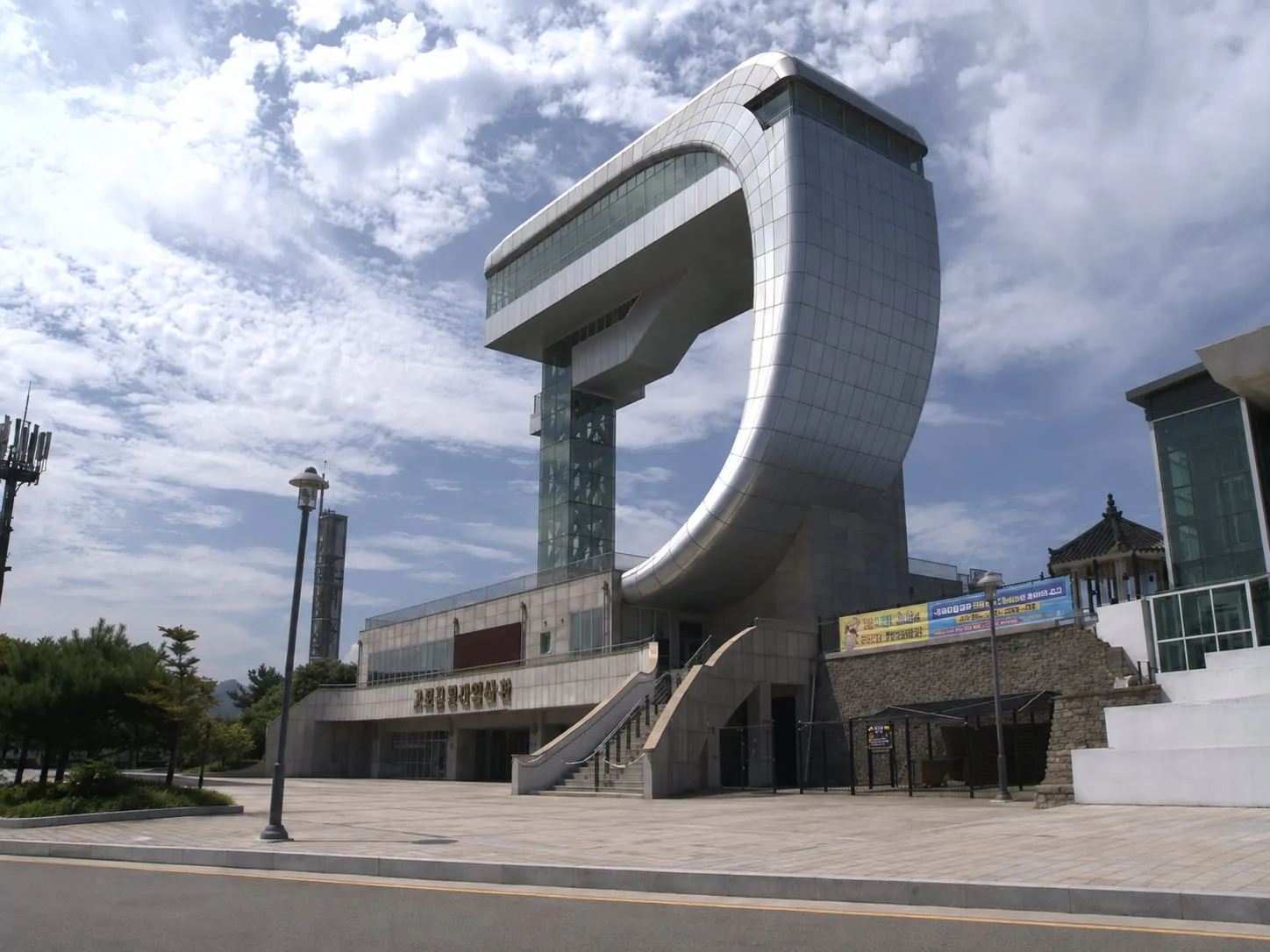
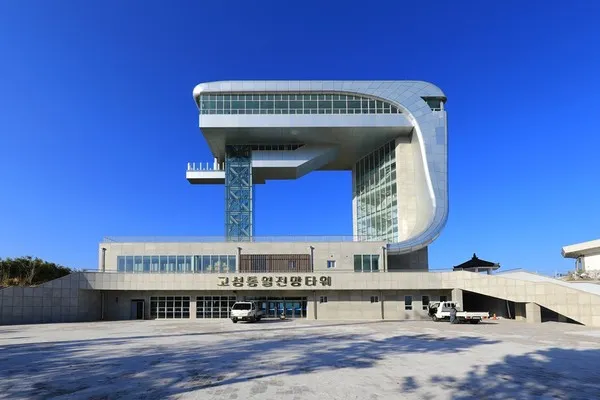
The building was rebuilt in December 2018. The ground floor has a café and a local produce shop, the second floor a unification exhibition hall, an education room and a lounge, and the fourth floor is the viewing deck and photo zone. There’s a lift, so elderly parents and pushchairs are no problem.
Entry procedure — the most important part of this article
This is not a place you can simply drive up to. It sits inside the Civilian Control Line, so there is a fixed procedure to follow.
In order:
Step 1 — register in advance on the entry app
Entry registration went digital on 30 June 2025. Search the App Store or Google Play for ‘고성군 통일전망대 출입 신고’ (Goseong-gun Unification Observatory Entry Report), download it free, and enter your visitor details ahead of time. It issues a QR-code electronic entry pass.
Registering early cuts down the paperwork on site. You can still do it in person without the app, but at weekends the app is clearly faster.
Step 2 — payment and the security briefing at the Unification Security Park entry office
The address is 481 Geumgangsan-ro, Hyeonnae-myeon, Goseong-gun. Put ‘Unification Security Park’ (통일안보공원) or ‘Unification Observatory entry office’ into your navigation. You go here first, not to the observatory. Plenty of people don’t know this, drive straight to the observatory, and have to turn back.
Here you pay the admission and parking fees and watch a security briefing video. It runs about ten minutes and every visitor watches it, no exceptions. When it ends, the screen tells you to return to your vehicle.
Step 3 — identity check at Jejin Checkpoint
It’s about 10 km from the entry office to the observatory. On the way, soldiers check identities at Jejin Checkpoint (제진검문소). Have your ID out and ready. Foreign visitors must carry the original passport. A copy or a photo on your phone will not do.
Step 4 — park at the observatory and look
Park at the observatory, go through a second check at the information centre, and you’re in. You may stay up to four hours (it used to be three; they extended it). That’s plenty.
Step 5 — hand the pass back on the way out
On your way out, return the Civilian Control Line vehicle pass at the same checkpoint you came through. That’s it.
The timing trap people miss Those 09:00–16:50 access hours are the cut-off at the entry office, not the observatory’s opening hours. Arrive at the office at 16:50 and you’re too late. Get there at least an hour before the cut-off.
You genuinely need a car
Let me put this one in bold.
Entry on foot, by bicycle or by motorbike is prohibited.
Inside the Civilian Control Line there are no exceptions. You cannot walk in and you cannot cycle in. A plan that involves reaching Sokcho by bus and then taking public transport to the Unification Observatory does not work.
If you don’t have a car, you have three options.
- Rental car — there are branches in central Sokcho and near Sokcho Express Bus Terminal. You’ll need an International Driving Permit.
- Chartered taxi — a return charter from Sokcho is the most realistic route. Agree the waiting time up front.
- A local tour — DMZ tours departing from Sokcho or Goseong handle the paperwork for you. For foreign guests this is by far the easiest option.
What you can actually see from up there
From the fourth-floor deck the view opens completely to the north.
- Haegeumgang — the “Kumgang of the sea”, a field of dramatic rock formations. On a good day almost all of it is in view at once.
- Guseonbong — the last peak of Mt. Kumgang. It looks close enough to touch. It’s also called Naktabong, Camel Peak, for its shape.
- The peaks of Mt. Kumgang (금강산) — 16 km away at the nearest, 25 km at the furthest. On a very clear day you can pick out Birobong, the highest peak, and Ongnyeobong.
- The Donghae Line railway — the line that once joined North and South, still running north and still stopped. This is the image that stays with me longest.
- The northern shoreline — waves breaking beyond the wire, and that same white sand simply carrying on to the north.
When the view is best
Honestly? It’s all down to the weather.
- Winter and late autumn are best — dry, clear air carries the view a long way. If you want to see the peaks of Mt. Kumgang, this is when your odds are highest.
- The summer rainy season, and spring fog and yellow dust — you’ll get the coastline, but don’t count on Mt. Kumgang.
- Go in the morning — sea haze builds through the afternoon and you end up shooting into the light. If photographs matter to you, mornings especially.
- Rainy days — visibility is close to nothing. Save the day for something else.
How it differs from Panmunjom and Imjingak
Most DMZ tourism in Korea sits near Seoul. Side by side, it looks like this.
| Panmunjom (JSA) | Imjingak & 3rd Tunnel | Goseong Unification Observatory | |
|---|---|---|---|
| Location | Paju, Gyeonggi | Paju, Gyeonggi | Goseong, Gangwon (east coast) |
| Advance booking | Required (months ahead) | Usually required | Not required |
| How to apply | Only through an authorised tour operator | Tour or independent | Independent visits via the app or on-site registration |
| What you see | Buildings on the Military Demarcation Line | Tunnel and exhibition hall | North Korean coastline and Mt. Kumgang |
| Atmosphere | Tense, tightly controlled | Exhibition and education | Sea and mountain scenery |
In short: Panmunjom is procedurally difficult and hard to book. The Unification Observatory you can decide on today and visit tomorrow. And this is the only northernmost observatory that sits on the sea. Nowhere else puts wire fence, breaking waves and northern mountains in a single frame.
There’s no need to rank them. They’re different things. But if fitting Panmunjom into your Seoul itinerary proved impossible, Sokcho and Goseong are a far more realistic alternative.
Rules inside the Civilian Control Line
Clearing the procedure doesn’t make it an open place. A few things you must observe.
- Do not leave the designated road. Some areas nearby still hold mines. It’s a safety issue, and if anyone strays, every other visitor who entered with you is held there until it’s resolved.
- No alcohol may be brought in.
- Photographing military installations and personnel is prohibited. Shooting northward from the deck and the photo zone is fine, but while you’re driving through, keep the camera away from guard posts, checkpoints and equipment.
- Absolutely no drones. It goes without saying, but I’ll say it anyway.
It may all feel like a hassle. But I think the procedure itself explains this place more accurately than anything else could. Reading about a divided country and handing over your ID at a checkpoint to go and look at it are completely different experiences.
Worth combining into the same trip
If you’ve come this far north, make a half-day of it.
- DMZ Museum — it sits inside the same entry procedure as the observatory. If you’ve already registered, you can visit with no extra formalities. It covers the nature of the DMZ and the history of the division, and it’s especially good with children.
- Jejin Station — the northernmost station on the southern side of the Donghae Line. Standing on a platform where no train stops is a strange feeling.
- Hwajinpo — a large lagoon on the way back down. Beach and lake sit right against each other, and with the Syngman Rhee and Lee Ki-poong villas and ‘Hwajinpo Castle’ (Kim Il-sung’s villa) all here, it doubles as a modern-history route.
Suggested order: Unification Observatory in the morning → DMZ Museum → lunch → Hwajinpo → back to Sokcho Half a day to a full day is comfortable. It slots neatly into a 1-night-2-days itinerary.
The drive up from Sokcho, and the drive back
From central Sokcho, take National Route 7 and keep heading north. The sea is on your right the whole way, so the drive is a pleasure in itself. About 50 minutes.
If you’re still working out how to reach us, it’s all in getting from Seoul to Sokcho and getting from Incheon Airport to Sokcho.
Stop by our place on the way back if you like. We’re directly in front of Sokcho Beach, a three-minute walk from Sokcho Express Bus Terminal. After a long look at the northern sea, you come down oddly hungry. Have a bowl of cold mulhoe before you go. Knowing the order to eat it in makes a real difference. If you are coming as a group, please call us ahead on +82-33-635-4488.
Why a Sokcho local is the one writing this
One last thing.
Sokcho is a town of displaced families. During the Korean War, people who came south stopped at this harbour for what they assumed would be a short while. Then the armistice line was drawn, they couldn’t go back, and this became home. The village that grew out of that is Sokcho’s Abai Village, and abai sundae and stuffed squid are northern food rebuilt out of southern ingredients.
So that coastline you’re looking at from the Unification Observatory — for the older people of Sokcho it is not a tourist view but the direction of the house they left behind.
Twice a year our restaurant invites around 300 elderly residents of Abai Village for a meal. A house that lives off the Sokcho sea giving something back to Sokcho just seems obvious to us.
If you stop at Abai Village after visiting the Unification Observatory, the view you saw through the telescope earlier will feel a little different. That, I think, is what this route is really worth.
See the menu · Directions · FAQ
See you in Sokcho.
You may also like