
Seoraksan Autumn Foliage Guide — Peak Timing, Trails by Difficulty, and Beating the Crowds
Sokcho travel · Sokcho Hangari Mulhoe
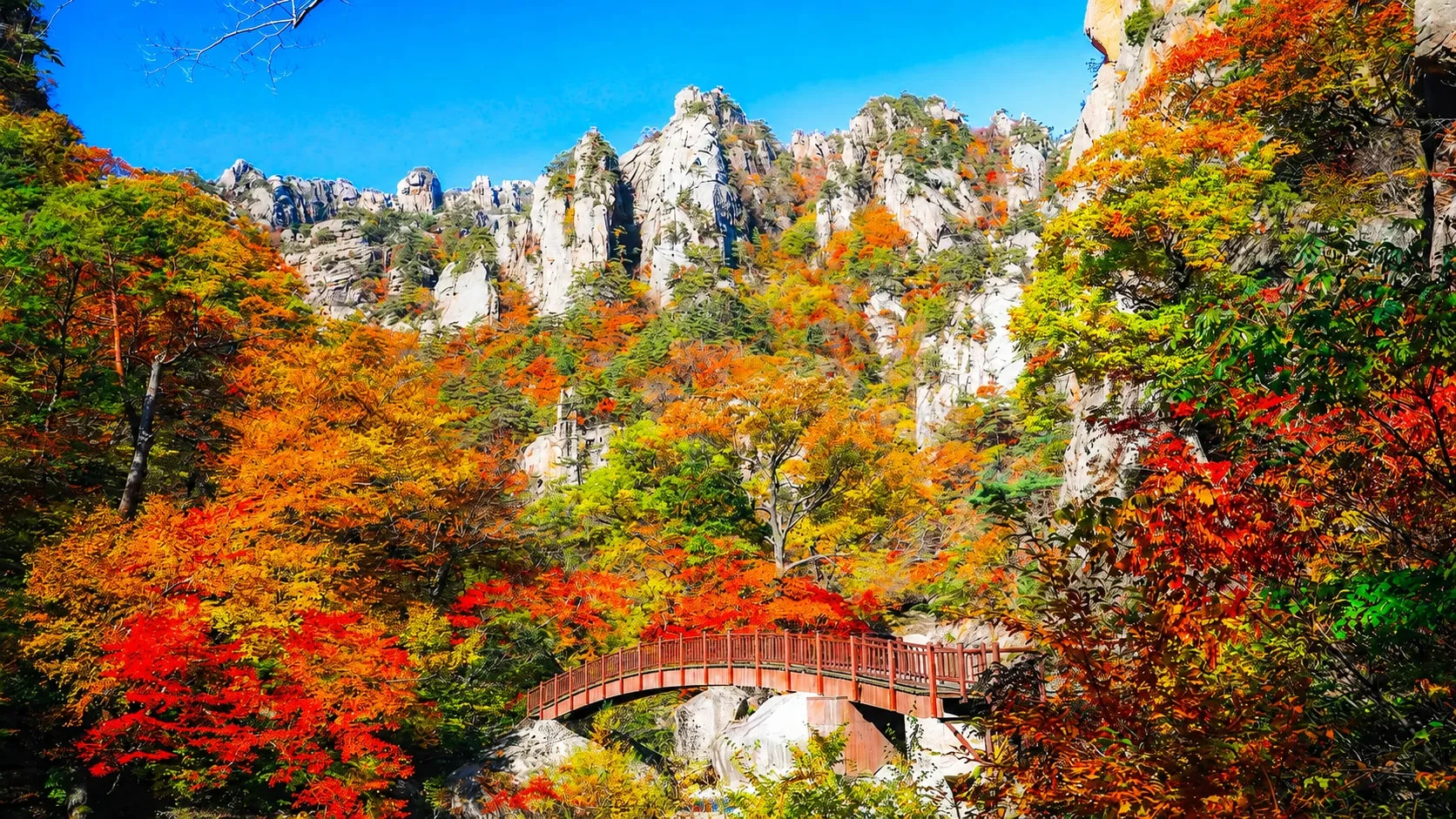
Every autumn our phone gets busy with the same questions. “When are the leaves best?” “Is it too late if I come next week?”
We were born and raised in Sokcho, and we watch the mountain change colour from our third-floor windows every year. So here is an honest, detailed answer — not the generic stuff you find everywhere, but things that will actually help when you get here.
When exactly does Seoraksan peak?
First, two different moments matter.
- First foliage — when about 20% of the mountain has turned. On Seoraksan this usually starts in late September to early October. It is the earliest in all of Korea.
- Peak — when more than 80% has turned. That comes roughly two weeks after first foliage, so Seoraksan generally peaks in mid-October, most often between October 10 and 20.
Here is the key point people miss. Seoraksan is tall, so colour moves from the top down. Daecheongbong summit turns first, then the mid-slopes, and finally the low ground near the park entrance.
So in early October the peaks look glorious while the base is still green. By late October the base is beautiful but the upper slopes have already dropped their leaves.
Mid-October is the only window when top and bottom are beautiful at the same time — which is exactly why everyone shows up then.
It shifts a little every year
A long, hot summer pushes the colours back about a week. A cool September with big day-night temperature swings pulls them forward. Recent years have trended later as summers stretch longer.
The reliable move is to check three or four days before you travel:
- Korea Meteorological Administration (weather.go.kr) foliage updates, refreshed weekly through October
- Seoraksan National Park’s official site for live photos and notices
- Search
#설악산단풍on Instagram or Naver sorted by newest — honestly this is the most accurate source. Nothing beats a photo somebody posted yesterday.
Call us and we will tell you what we can see. We look at that mountain every day.
Trails by fitness level — you don’t need hiking boots
People assume you must be a serious hiker to see Seoraksan’s colours. Not true at all. Several routes are fine in ordinary sneakers.
1. Very easy — Sogongwon stroll (30 min to 1 hour, ★☆☆)
Flat path from the Seorakdong Sogongwon entrance past Sinheungsa Temple to the Great Unification Buddha. Strollers roll fine and older visitors manage comfortably.
The big bronze Buddha framed by red maples with the Ulsanbawi ridgeline behind it is far more impressive than it sounds. Perfect if you want the colours without the climb.
2. Our top pick — Biryong Falls & Towangseong Falls viewpoint (3 hours round trip, ★★☆)
This is what we recommend most in autumn. Sogongwon → Yukdam Falls → Biryong Falls → Towangseong viewpoint is 2.8 km one way; allow three to four relaxed hours round trip.
You walk along a stream the whole way, so you get water sounds with your foliage, and the colours reflected on the water photograph beautifully. The first stretch is gentle; only the final viewpoint section has real stairs. If you walk regularly you will be fine.
3. Worth the effort — Ulsanbawi Rock (4 hours round trip, ★★★)
Past the Rocking Rock and up 808 steps to the 873 m summit of Ulsanbawi. Those stairs are no joke — you will stop to breathe several times.
But from the top you see the Seoraksan ridges, Sokcho city, and the East Sea all at once. You will understand what floating above the foliage means.
Bring trekking poles if your knees are weak; the descent is harder than the climb.
4. Effortless — Gwongeumseong by cable car (1.5 hours, ★☆☆)
If walking is difficult, or you have small children or elderly parents, the cable car is the answer. Ten minutes gets you up to mid-mountain to look down over the colours. Fares, hours and queue tactics are in our separate Seoraksan cable car guide.
5. A bit further — Jujeongol Valley (3 hours round trip, ★★☆)
This one is on the Osaek side in Yangyang, about 40 minutes by car from Sokcho. Mostly boardwalk, so it is easy walking, yet the valley scenery is dramatic. A good alternative when Sogongwon is overrun.
How to avoid the crowds — this is the real advice
Honestly: mid-October weekends at Seoraksan are packed. The Sogongwon car park starts filling by 8 a.m. and cable car waits can hit two hours.
After years of watching this, here is what works.
One — go on a weekday. If you can manage it, nothing else comes close. Tuesday through Thursday runs about a third of weekend volume.
Two — if it must be a weekend, arrive before 7 a.m., 8 at the latest. After 9 you start queueing just to enter the car park.
Three — try after 3 p.m. This surprises people, but crowds thin out sharply late in the day. Low autumn light also makes the colours look richer. Just pick a short route, because darkness comes early.
Four — go the weekend before peak. The week the news declares “peak” pulls visitors from the whole country. The previous weekend is already about 80% turned, with half the people.
Getting there and parking
- From central Sokcho to Seorakdong Sogongwon is 20–25 minutes by car. About the same from our restaurant.
- By bus, take city bus 7 or 7-1 from Sokcho Intercity Bus Terminal or near Sokcho Beach. Around 40 minutes, and buses are infrequent — check the timetable first.
- Parking is at the Sogongwon lot, which frequently fills on autumn weekends. When full you are directed to overflow lots further down, then walk or take a shuttle.
- There is no park entrance fee (abolished in 2007). You only pay for parking, and the cable car separately.
What to bring
October on the mountain is colder than you expect — roughly 5–7°C below Sokcho town. Every year we meet people who set out in short sleeves and shivered at the top.
- A light windbreaker — packs small, makes all the difference
- Water and a snack — there are almost no shops on the trails
- Comfortable shoes — cushioned sneakers are fine; boots not required
- A power bank — you will take many photos and cold drains batteries fast
- Hat and sunglasses — autumn sun is sharper than it looks
And when you come back down
After three or four hours on the mountain your legs ache and you are properly hungry. Many people reach for something hot, but we would suggest the opposite: ice-cold mulhoe.
That first sip of tangy chilled broth after a sweaty descent drops your body temperature and wakes you right up. The tiredness rinses away. Finish by stirring rice into what’s left of the broth and you leave genuinely full.
We are about 20 minutes by car from Seorakdong, and Sokcho Beach is directly behind our building — so you can look at the sea before heading home. Autumn sea has a quieter, deeper colour than summer.
We have a large third-floor hall for hiking groups. If there are many of you, please call ahead — autumn fills up fast.
From our Sky Stairs rooftop viewpoint you can see the sea and the Sokcho Eye ferris wheel in one frame. Go up for a photo after your meal.
See the menu · Directions and parking
Autumn on Seoraksan really is something. Travel safely, and eat well.
You may also like