
How to Use a Korean Restaurant — The Call Bell, the Free Side Dishes, and Why Nobody Tips
Visit tips · Sokcho Hangari Mulhoe
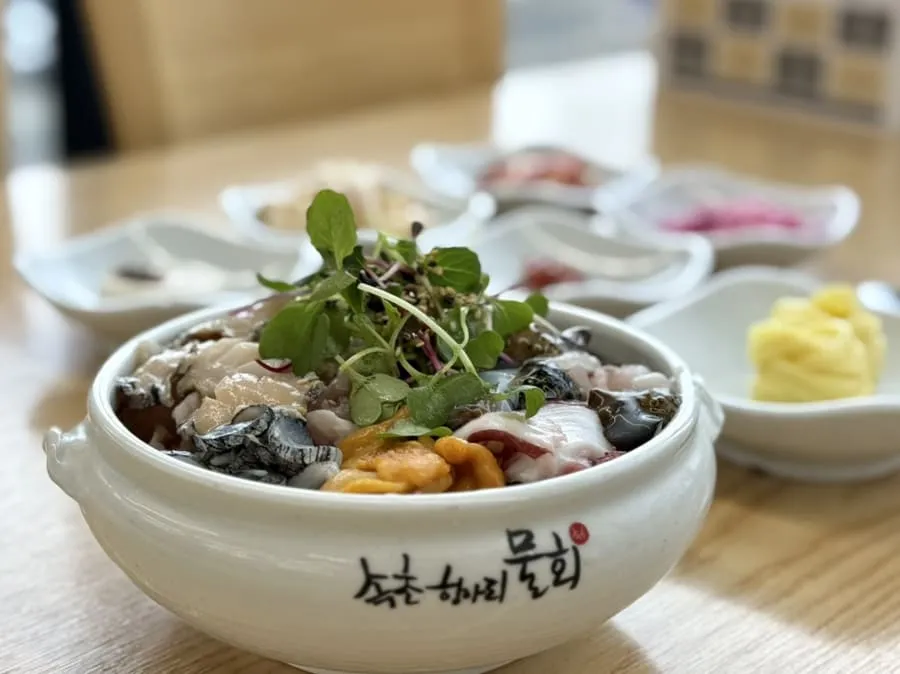
I run a mulhoe restaurant on Sokcho Beach, and I watch the same small hesitations happen every day.
A guest sits down, and then waits. Catches my eye, looks away, waits some more. Or reaches for the little dishes and stops, unsure whether they will appear on the bill. Or finishes the meal and sits there with money in hand, wondering who to give it to.
None of this is about knowing how to eat. It is that a Korean dining room runs on a set of rules nobody ever writes down, because everyone here learned them at five years old. So let me write them down, from the other side of the counter.
1. Press the button. Nobody is ignoring you.
Look at your table. There is probably a small button on it — the call bell (호출벨).
Press it. That is the whole system. Staff will come.
If there is no bell, say “저기요” (jeo-gi-yo) — “excuse me” — out loud, across the room. Not a whisper. Not a raised hand held hopefully in the air. Out loud. “여기요” (yeo-gi-yo) works too.
This is the single thing I most want visitors to know, because the misunderstanding runs deep. In many countries a server comes back to your table on their own — “how is everything?” — and being left alone would mean something was wrong. In Korea it is the opposite. Leaving you undisturbed is the courtesy. We are not hovering because we assume you would like to eat your meal in peace.
So the guest waits politely for us, and we wait politely for the guest, and everyone’s food gets colder. Press the button. It is not rude. It is the only way we know you need something.
2. The little dishes are free. So are the refills.
Those small plates that arrived without you ordering them are banchan (반찬) — side dishes.
They are included. You will not find them on the bill. And when one runs out, you can ask for more, also free. Point at the empty dish and say “더 주세요” (deo ju-se-yo) — “more, please.” Some restaurants have a self-service bar along the wall where you help yourself.
Here is the part that makes those free refills trustworthy, and almost no visitor knows it: Korean law forbids a restaurant from reusing any food that has been served to a table. Not a house policy — the Food Sanitation Act, with prison time and heavy fines attached. Every dish you send back is thrown away, everywhere in the country.
Which leads to one request from the kitchen side: take what you will actually eat. A refill is genuinely better than a mountain at the start. Ask twice, ask three times, we do not mind at all.
3. Water is free, and you usually pour it yourself.
Look for a bottle or a dispenser, with cups stacked beside it — on your table, on a side table, or against the wall. Help yourself.
It is free, always, everywhere in Korea, and nobody will bring it unless you ask. If you cannot find it, that is what the call bell is for: “물 주세요” (mul ju-se-yo) — “water, please.”
4. There is no tipping. The price on the menu is the price you pay.
The number next to the dish already includes tax. Nothing gets added at the end. Nothing is expected at the end.
If you leave money on the table, a member of staff will very likely run after you into the street to return it, convinced you forgot it. That is not a joke — it is the normal outcome, and it makes for an awkward moment for both of you.
You may occasionally spot a tip jar at a fashionable café in Seoul. It is new, it is argued about in the Korean press, and it is not expected of you.
What you can do instead, and what genuinely lands: on the way out, say “잘 먹었습니다” (jal meo-geot-seum-ni-da) — “I ate well.” Every restaurant owner in this country would rather hear that than take your money.
5. You pay at the counter, on the way out — or at the kiosk, up front
The older and still most common pattern: the bill slip is left on your table when the food arrives. Do not wait for someone to collect it. Pick it up, carry it to the register by the door, and pay there as you leave.
The newer pattern, spreading fast: the ordering kiosk on your table takes your card the moment you order. You choose, you tap, you are done — and there is nothing left to do at the end but stand up and leave. If that is how a place works, the kiosk will make it obvious.
At our restaurant, paying at the kiosk when you order is the usual way — but you can still settle up at the counter on your way out if you would rather. Either is fine; just do whichever feels easier.
- Cards work everywhere, including tiny places. You will rarely need cash.
- One person usually pays for the whole table. Splitting is possible and increasingly normal — just hand over two cards and say the amounts.
- If you would rather pay at the table in an older place, press the bell and say “계산할게요” (gye-san-hal-ge-yo) — “I’ll pay.”
6. If you are eating alone, check for the two-serving rule
Some dishes — barbecue, big stews, hot pots — carry a two-serving minimum (2인분 이상).
This is worth explaining honestly, because it stings when you do not know why. It is not aimed at foreigners. It is that the cost of setting a table barely changes between one person and two: the same charcoal, the same grill to clean, the same full spread of side dishes. One order does not cover it.
It is also disappearing quickly. Solo dining — honbap (혼밥) — is completely ordinary in Korea now, and more restaurants drop the rule every year.
At our place it never applies. Mulhoe is served one earthenware bowl per person, so a single guest is simply a single guest. We open at nine in the morning, and people eat alone here all day long.
7. The table manners that actually matter
Short list. These are the ones a Korean would notice.
| Do this | Why |
|---|---|
| Leave the rice and soup bowls on the table and eat from them with your spoon | This is the opposite of Japan and China, and it is the one that surprises people. Lifting a bowl to your mouth looks distinctly odd here. |
| Spoon for rice and soup, chopsticks for everything else | And not both in the same hand at once — set one down to use the other. |
| Never stand chopsticks upright in rice | That is how food is offered to the dead at a memorial rite. It reads as a bad omen, not a small slip. |
| If you are with Koreans, let the eldest lift their spoon first | A half-second of waiting. It is noticed, and it is appreciated. |
| Pour for other people, not for yourself — two hands if they are older | Someone will fill your glass. Fill theirs back. |
About the shared stew in the middle of the table: eating straight from the communal pot is completely normal here. If you would rather not, ask for “앞접시” (ap-jeop-si) — a small plate to portion onto. Nobody will think anything of it.
8. Shoes off — sometimes
If you see a raised wooden platform with a shoe rack at its edge, that is floor seating, and shoes come off before you step up. Other people’s shoes lined up at the entrance are your clue.
Practical advice from someone who has watched this go wrong: wear socks you would not mind being seen in.
Our dining rooms are table-and-chair seating, so this one does not come up here — but you will meet it somewhere in Korea, probably at a good place worth eating at.
9. Ordering when you do not speak a word of Korean
This is genuinely not a problem, and it is the worry I most want to remove.
- Point at the photo. Korean menus are full of pictures, precisely because this works.
- “이거 주세요” (i-geo ju-se-yo) — “this one, please.” One phrase, and you can order anything on any menu in Korea.
- Use Papago rather than Google Translate for Korean. It handles the language noticeably better.
- Table kiosks often have a language button. Ours does, and it shows a photo of every dish. You can switch to your own language, tap the picture, pay by card, and complete an entire meal without speaking a word to anyone. If that is what you need today, it is genuinely fine.
Our full menu is on this site in fourteen languages. Open it on your phone before you come and the whole thing takes a minute.
One thing you must tell us, in any language, however you can: any allergy, before you order. Most of what we make uses live seafood. Say the word “allergy,” point at yourself, show us your phone — we will find you something safe.
10. Things you are worried about that do not matter
- Slurping noodles — fine. Nobody looks up.
- Not finishing your food — fine. No offence taken.
- Being clumsy with metal chopsticks — they are slippery and Koreans drop things with them too. Nobody is scoring you.
- The noise level — Korean dining rooms are loud and cheerful. You are not being rude by talking.
- Saying thank you too many times — please continue. It never once bothered anyone.
The short version
- Press the call bell, or say “저기요” out loud. Staff are not ignoring you — they are leaving you alone on purpose.
- Side dishes and water are free, and refills are free too. Ask. Nothing served is ever reused — that is the law.
- No tipping. Menu price is final price. Say “잘 먹었습니다” instead.
- Pay at the counter on the way out, or by card at the table kiosk when you order. Cards everywhere.
- Bowls stay on the table; eat rice with the spoon. Never stand chopsticks up in rice.
- Point at the photo and say “이거 주세요.” That is a complete ordering skill.
If you are coming to Sokcho, mulhoe is our summer dish — chilled raw fish in an icy sweet-tart broth — and there is an order to eat it in that makes a real difference. If you are wondering about the raw fish at all, we wrote about exactly how that works.
Come hungry. Press the button. We will do the rest.
See the menu · Find us · FAQ · +82-33-635-4488
You may also like